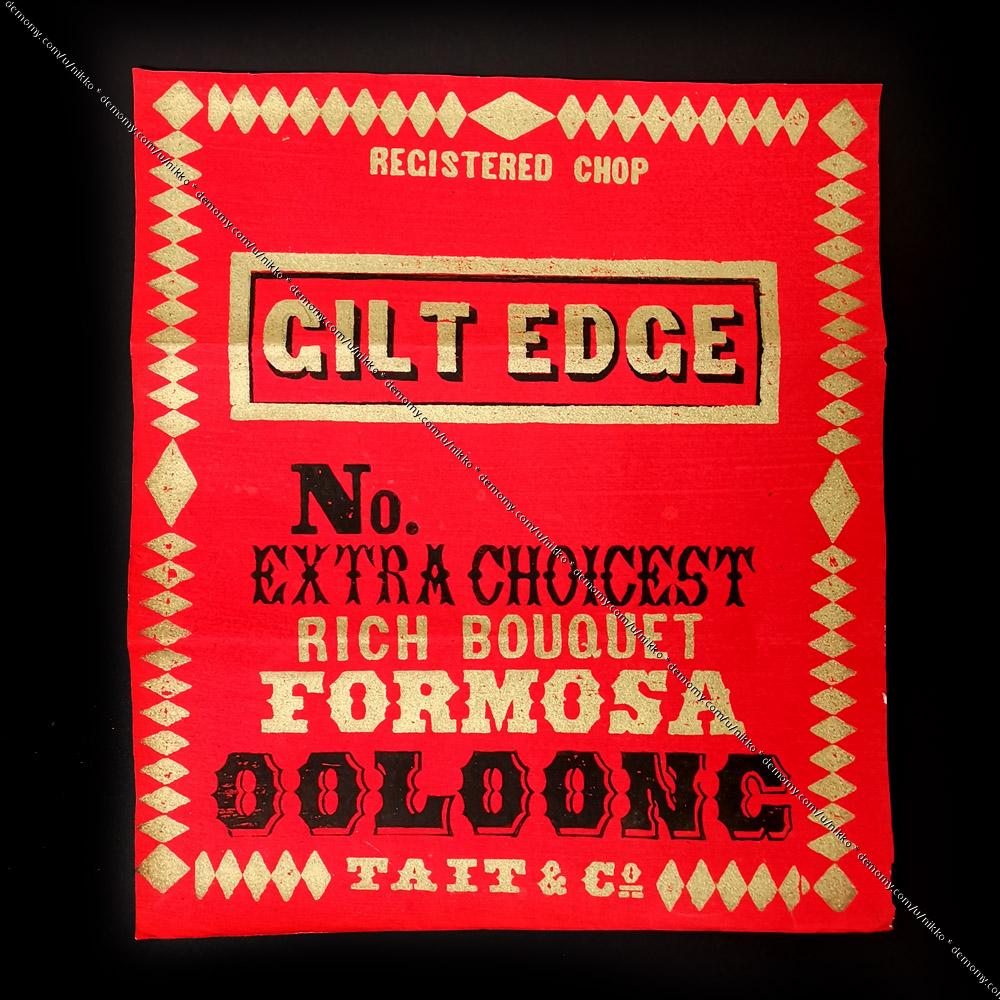
This is a Formosa Oolong tea box label by the British company Tait & Co. At the time, American tea drinking habits were not as predominantly black tea as they are today, so Taiwan Oolong tea merchants actively exported to the American market. Back then, black tea was exported in wooden boxes lined with tin foil, and this label was affixed to the outside of the boxes.

(Photo of the Oolong tea box lined with tin foil)
Tait & Co., a subsidiary of the British East India Company, was founded in 1845 in Xiamen, Fujian, by Englishman James Tait. In 1867, it established a branch in Anping, Tainan, and built a sales office. In 1878, it established a branch in Tamsui, and in 1887, it established a branch in Dadaocheng. After Taiwan was ceded to Japan in 1895, the Japanese government implemented a monopoly on the sale of goods and supported Japanese trading companies, leading to the gradual withdrawal of foreign firms from the Taiwanese oolong tea market. In 1911, the T.K. & Co. finally ceased its operations in Taiwan, closing its Anping branch. The existing T.K. & Co. is merely a name-shared entity and has no connection to the original British company.
Due to limited documentation, it is difficult to pinpoint the exact year this label was used. In generally, its use likely coincides with T.K. & Co.'s operations in Taiwan, between 1867 and 1911. However, given the extremely primitive woodblock printing technology used and the Japanese government's suppression of foreign firms, it is speculated that the peak usage of this type of labels occurred before Taiwan was ceded.
Because the label itself was made of rice paper and printed using woodblock printing, with water-soluble pigments and adhesives, it was virtually impossible to remove completely once affixed, potentially preventing counterfeiting through the reuse of labels. Most of the remaining labels are old stocks found in the warehouses. Besides from those already collected by museums, it is rarely seen on the market. Due to the increasing popularity of Taiwanese oolong tea and related historical topics in recent years, this type of labels has become increasingly sought after by the collectors.